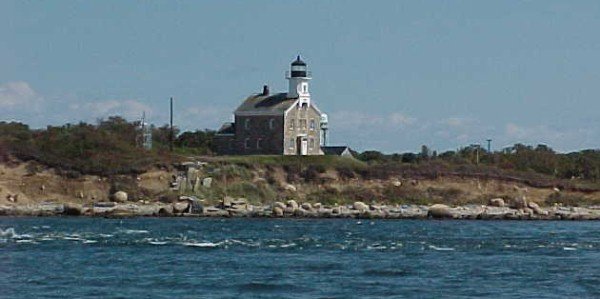
Save The Plum Island Lighthouse
After 21 years of abandonment and neglect, there's now hope for the 1869 lighthouse on the west end of Plum Island. Please take a few minutes to learn the history of the island and light station, what's now being done and how you can help.
[History of Plum Island] [About Plum Gut] [History of the Light Station] [What's Being Done to Save the Lighthouse] [The Goal] [How You Can Help] [About the East End Seaport Museum and Marine Foundation] [How to Stay Informed About the Effort] [Print Out A Petition]
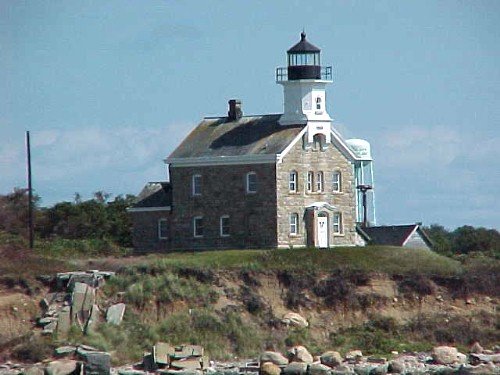
On the left foreground you can see the remains of a generator house. This structure fell into the sea in the late 1990's as a result of the continuing erosion. If the erosion is not stopped, it will one day claim the lighthouse.
Plum Island is an 840-acre island off the tip of Long Island's North Fork. It was created by the same glacial action that created Long Island about 15,000 years ago. The first "owner" of Plum Island was Samuel Wyllys who reportedly "bought" the island, known to the Indians as Manittuwand, in 1659 from the Indian chief Wyandanch. The purchase price was "one coat, one barrel of biscuits and 100 fish-hooks." Wyandanch was one of four brothers and there was a dispute over whether he had the right to sell the island without their consent. In 1665, the Town of Southold bought the island from one of Wyandanch's brothers. Eventually, Wyllys's claim was victorious when Wyandanch's brothers died and left him as the only chief for the four tribes. In 1675 Wyllys received a patent of confirmation for "Plumme Island" from New York's Governor, Edmund Andros.
Wyllys sold the island in 1699 to Joseph Dudley for 250 New England pounds. In 1700, Dudley sold the island to Joseph and William Beebee, who then sold the island in 1732 to Daniel Tuthil for $1700.
In 1775, Plum Gut was the site of the first battle between British and Continental troops. General George Washington ordered General Wooster and his troops to land (near the site of the present lighthouse) to prevent livestock raids by the British. This was the first amphibious landing under fire by American troops.
The federal government bought 150 acres on the west end of the island in 1897 from Abraham Hewitt for $25,000 for the erection of Fort Terry, a military post which was part of a network of artillery posts intended to protect the area from naval attack during the Spanish-American War (The other posts were Fort Michie on Great Gull Island, Fort Wright on Fishers Island, and Fort Tyler on the site of the former Gardiner's Point lighthouse. None of these posts ever fired a shot other than for practice). After the Spanish-American War the government bought the rest of the island.
In 1930, the Justice Department considered making a 1000-cell prison on the island, but the deal never went through. It was deemed impractical.
Fort Terry was deactivated after WWII, but was reactivated in April of 1952 for "Chemical Corps activities." In July of that year, the Agriculture Department established a research center for hoof and mouth disease in cattle. After spending $4 million on the chemical warfare facility, the Army turned it over to the Agriculture Department in 1954. The USDA animal disease research center has continued on to this day and is the reason the island has been off-limits to the public for 45 years. In 1999, it was announced that the government is contemplating adding biological warfare research to its presence on the island.
Plum Island is separated from Orient Point by a mile-wide waterway called Plum Gut. Through this waterway passes much of the tidal water of the Long Island Sound (It shares this duty with The Race, another dangerous waterway further east between Little Gull Island and Fishers Island). Because of the venturi effect caused by the narrow waterway, currents often run as high as four or five knots. The shoals in the Gut, aside from being a danger to ships in themselves, cause waves as high as six feet as tidal waters pass over them.
History of the Plum Island Light Station
In August of 1826, the Local Superintendent of Light-Houses at Sag Harbor issued a call for proposals for the construction of "a Light-House and Dwelling-House on Plumb Island." The specification for the station included a 30-foot tall octagonal pyramid tower built of rough stone and a separate keeper's quarters. The tower's lantern was to cast iron and fitted with Winslow Lewis's patent lamps. In 1856, the lighting apparatus was changed to a fourth order Fresnel lens.
By the late 1860s, the original light was in poor condition and it was rebuilt in 1869. The new light, which still stands, is of the same design as other area lights such as Block Island North, Morgan Point, Sheffield Island, Great Captain's Island and Old Field Point.
In 1899, the Orient Point lighthouse was built on the western side of the Gut and the two served mariners navigating the waterway for 79 years. In 1978, the lighthouse was decommissioned and has since fallen into a state of disrepair. While the USDA claims to have rights to the lighthouse property, no documentation has been found showing the transfer of the property to the USDA either before, or after, the decommissioning of the lighthouse. In 1994, the Fresnel lens and clockwork mechanism were removed and are now on display at the East End Seaport Museum in Greenport. The structure has been, and still is, threatened by neglect and erosion of the bluff upon which it stands. In the late 1990s, a generator house at the station fell into the water. With the many storms that hit the area, including hurricanes, tropical storms and nor'easters, the future of the lighthouse is uncertain.
What's Being Done to Save the Lighthouse
The East End Seaport Marine Foundation is now preparing a restoration effort for this light. Among the steps underway are the following:
The light's complete history is being researched
Federal, State, County and Town officials are being contacted and their assistance is being requested.
The support of lighthouse lovers everywhere is being sought.
The support of other lighthouse preservation societies is being sought.
The support of the USDA Animal Disease Research Center on Plum Island is being sought.
A press packet with photographs, background history, and an outline of the effort is being prepared.
Magazine and newspaper articles are being written. Such an article, by Foundation Directors Merlon Wiggin and Robert G. Muller, appeared in the January 2000 issue of Lighthouse Digest.
Pro bono services of marine contractors for the placement of rock and stone for bluff stabilization have already been procured.
The goal of this effort is to have the lighthouse leased to the East End Seaport Museum and Marine Foundation. The stabilization of the bluff will be a main priority, and electric, water, sanitary and trash issues will be addressed. The lighthouse will then be made open to the public on a restricted basis (due to USDA concerns) and may be available for use as an executive conference building or similar use as a source of funds for maintenance. Members of the East End Seaport Lighthouse Committee will handle maintenance and repairs as necessary.
Public support is needed for this project. If you'd like to help in any way, please call the East End Seaport Marine Foundation's Lighthouse Committee at 631-477-2121 or email them at lighthouse@peconic.net. You may visit their site at www.eastendlighthouses.org. The Foundation's main site is located at www.eastendseaport.org.
About the East End Seaport Museum and Marine Foundation
The Foundation was formed in 1990 for the restoration of the Long Beach Bar (Bug) Lighthouse. The Foundation successfully maintains that lighthouse, a museum of local maritime history, and an operating blacksmith shop. Among the exhibits at the museum are the Fresnel lenses from the Plum Island and Little Gull Island lighthouses and photos of the entire restoration of the Bug Light. Each June, the Foundation arranges a lighthouse cruise. This annual cruise, which shows the area's lighthouses to about 300 people, always sells out long before its June occurrence.
How to Stay Informed About the Effort
East End Seaport members will be kept informed through Foundation publications. Updates will also be posted on www.eastendseaport.org, www.eastendlighthouses.org, and www.longislandlighthouses.com . The Long Island lighthouses e-mail list gives regular updates on this project, other restoration and preservation efforts, and other Long Island lighthouse matters. Click Here to join the list.
Return the LongIslandLighthouses.com Home Page
Visit the Plum Island page
Visit the web site of the East End Seaport Museum and Marine Foundation.
Visit the web site of the Foundation's Lighthouse Committee.
You may print out a petition to help the East End Seaport. Make as many copies as you'd like and send the full ones to the East End Seaport address on the petition.
Text and code on this page Copyright © 1999, 2000 Robert G. Muller. Photographs courtesy of Diane Mancini. The text and photographs on this page may be used in non-commercial ways, but please contact the above individuals, as a courtesy, if you do so. Thanks. :-)